

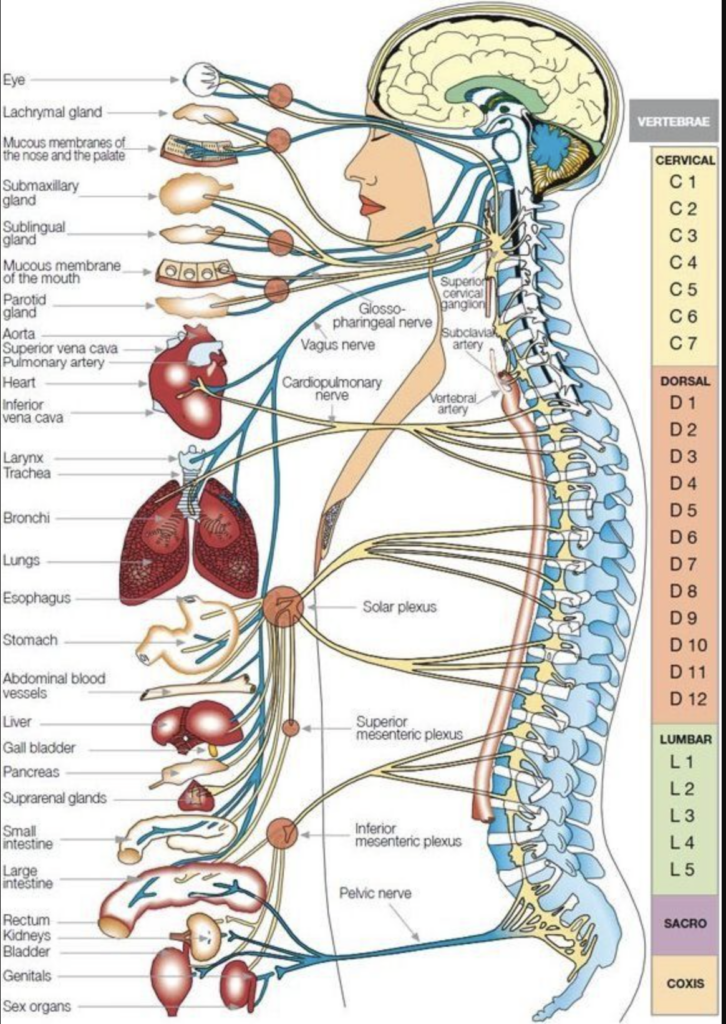
Your spine is more than a stack of bones—it’s the central pathway your brain uses to communicate with every part of your body. Running through the center of the spine is the spinal cord, a major information highway that carries signals to your organs, muscles, and glands. From this pathway, thousands of nerves branch outward, forming intricate connections that help regulate your heartbeat, breathing, digestion, immune responses, and countless other functions you never have to think about. When the spine is healthy and moving well, these messages travel smoothly, supporting your body’s natural ability to heal, adapt, and stay balanced.
In chiropractic care, we pay close attention to how each region of the spine influences different organs and systems. The upper cervical spine, for example, helps support clear communication with the head, eyes, sinuses, and certain glands. The mid‑back connects with the heart and lungs, while the lower spine influences digestion, reproductive organs, and the bladder. These relationships exist because the autonomic nervous system—your body’s built‑in regulator for “rest and repair” and “energy and alertness”—travels through and alongside the spine. When this system is functioning well, your body can respond appropriately to stress, maintain healthy organ function, and keep internal processes running smoothly.
However, when the spine becomes stiff, irritated, or misaligned, it can place pressure or tension on the nerves that travel through these pathways. Even small disruptions can interfere with how clearly signals move between the brain and the organs they serve. This doesn’t always cause pain right away. Sometimes it shows up as fatigue, digestive changes, shallow breathing, or a general sense that your body isn’t functioning at its best. Chiropractic adjustments aim to restore healthy motion and alignment in the spine, helping reduce nerve irritation and improve the clarity of these vital connections.
Think of the spine as the main electrical panel of your body. Each nerve is like a wire leading to a specific room or appliance. If a breaker is overloaded or a wire is pinched, the signal weakens. Chiropractic care helps ensure that each part of the system is open, balanced, and functioning the way it was designed to. When the spine is moving well, the nervous system can send stronger, clearer messages to the organs, supporting better overall health.
Many patients are surprised to learn how closely their posture and daily habits influence these spinal pathways. Long hours of sitting, stress, old injuries, or repetitive movements can gradually affect how the spine moves. Over time, these changes can impact the quality of nerve communication. Regular chiropractic check‑ups help identify and correct these issues early, keeping the spine flexible and the nervous system functioning at its best.
By understanding the powerful connections between your spine and your organs, you gain a clearer picture of why chiropractic care focuses on whole‑body wellness rather than just pain relief. A healthy spine supports a healthy nervous system, and a healthy nervous system supports every organ in your body. When these pathways are open and functioning well, your body is better equipped to heal, adapt, and thrive.